What is Sacred?
tl;dr: We humans share a quiet, embodied sense of what is sacred. Not through doctrine or belief, but through recognition. This thin but resilient layer of shared sacredness may be enough to hold us together, if we slow down, pay attention, and remember that not everything is meant to be used.
I hope you are finding time to rest and mark this season of transition.
This time of year often brings me back to a question I return to again and again:
How do human beings share a sense of what is sacred?
It is a gift to live in a society that aspires to pluralism. Even when it falls short of its own ideals.
Pluralism is not easy to pull off. It asks us to coexist across deep difference. A sense of difference that becomes especially acute when it comes to questions of meaning, value, and the sacred.
These tensions come to the fore during a season anchored by a Christian holiday and the dominance of the Gregorian calendar. These markers structure public life. And yet they are so familiar that they can feel invisible to most people.
(You can scroll to the end for a postscript naming the values of pluralism. God(!?) knows we need to remember!)
I spend a lot of time thinking about pluralism. I feel its tensions when confronted with the rigidities of a fundamentalist left. And even more so as we collectively face a radical right aggressively wielding power. In times like these, it is tempting to assume that we just don’t have enough in common.
And yet.
What I keep noticing is this:
Even in a dominant culture that strips life of mystery and reduces everything to scientific materialism, most people still carry an embodied sense of what is sacred.
So what I’m really asking is whether, beneath our disagreements, there is still a thin but resilient layer of shared sacredness. And if it is enough to hold us together.
Not shared beliefs.
Not shared doctrines.
But shared recognition.
Take a moment and ask yourself:
What does the word sacred evoke for you?
For some, the word carries the weight of religious trauma. Or narrowed by inherited frameworks that no longer fit. And still, there are deeply religious people whose faith has made them more expansive in their sensitivity to what feels inviolable. Theirs is a faith that includes.
I don’t think we need agreement about origins, metaphysics, or ultimate meaning to notice the sacred. I think it is often recognized in the body before it is argued in the mind.
Consider this: no human being experienced what astronauts now call the “overview effect” until the 1960s. And yet those who see the Earth from space routinely describe an unmistakable encounter with the sacred. An overwhelming sense of fragility, unity, and responsibility. That experience would not exist without modern science, and yet it reliably dissolves borders and instrumental thinking.
Something similar is happening in the midst of the psychedelic renaissance. Even as these experiences are increasingly framed through narrow medical or therapeutic lenses, many people return describing encounters that feel reverent, humbling, and profoundly meaningful. Whatever language is used, the recognition is familiar.
But you don’t need to go to space.
And you don’t need psychedelics.
(Although I tend to recommend them.)
You can pause. Breathe. Feel your body. Feel the ground beneath you. And ask again:
What do you already know about the sacred?
If there is a shared layer here, it may be thinner than religious systems. But it is also more resilient. t shows up again and again, across cultures and eras
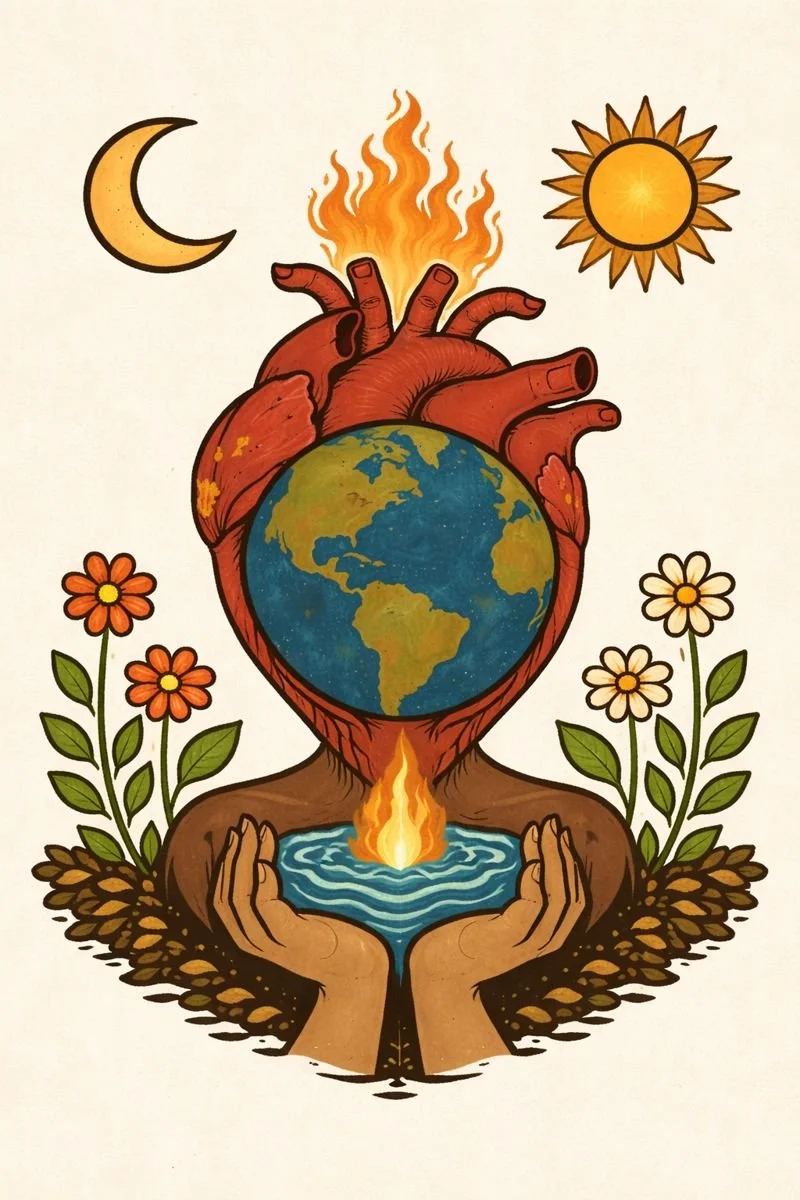
It is felt as:
Life itself
Across profound disagreement, unnecessary harm to life is felt as a violation. The death of a child. The suffering of innocents. The fragility of living beings. People may disagree about definitions and boundaries, but grief and moral weight arise almost everywhere.
Awe
A night sky. A storm. A vast landscape. A moment that makes us quiet and careful. Awe carries the recognition: this is bigger than me, and I should move differently here.
The body
Torture horrifies. Sexual violation wounds across every culture. Desecration of the dead feels wrong. The body is where vulnerability and dignity meet, which is why birth, illness, sex, and death are so often ritualized.
Grief and mourning
Every culture marks death. Grief cannot be optimized or rushed without something breaking. To interrupt, mock, or exploit it feels profane. Mourning slows time and reveals what cannot be replaced.
Love freely given
Not love as a transaction or possession, but love as a gift. Care offered without guarantee. Loyalty when it is costly. Even the most cynical among us recognize this as something higher when we encounter it directly.
The Living Earth
Across cultures and cosmologies, land, water, and non-human life are treated as more than resources. Rivers are mourned when poisoned. Forests are grieved when razed. Animals are thanked, named, or prayed over when killed for food.
Even in industrial societies, there is a shared intuition that some places should not be desecrated and some losses cannot be justified as “progress.” The natural world evokes restraint, reciprocity, and care. Not because it belongs to us, but because we belong within it.
What all of these share is not belief, but reverence.
The sacred seems to arise wherever humans sense fragility, irreplaceability, and continuity beyond the individual.
You don’t need theology for that.
You need attention.
Perhaps the deepest shared intuition is this:
Not everything should be used.
When everything becomes instrumental, people, bodies, time, truth, something in us recoils.
Art, music, ceremony, silence, and even secular forms of prayer are ways humans insist that not everything exists for profit, control, or efficiency.
I know it often feels as though we are far from this shared understanding. But I don’t think it’s gone.
It can go quiet. Becomes easier to miss. But it is still recognizable. It often catches us by surprise without us making any effort, like a revelation, a piercing beyond the veil. Otherwise, all it takes is our willingness to slow down and notice what our bodies already know.
Do it Together
We are in the midst of a beautiful time of year to gather with others. Come together and light a few candles. Pour some libations. Share a meal. Ask one another not what you believe, but how do you recognize when something feels sacred.
Be patient with the ways others express discomfort before consenting to a conversation that their hearts actually long for.
Stay attuned to what you feel. Both in your body, and in the space alive between you.
Get really curious.
Hold a quiet calming breath.
Consider allowing your heart to speak a prayer.
And the sacred might make itself visible right there.
The Values of Pluralism
(Because it’s good to be reminded)
1. Human dignity is non-negotiable
No worldview, religious, secular, ideological, gets to strip another human of basic worth. You don’t have to agree with someone’s beliefs to agree that:
Their life matters.
Their suffering counts.
Their voice deserves to be heard.
This is the moral floor beneath disagreement.
2. Difference is real. Not a problem to be solved
Pluralism rejects the fantasy of eventual sameness. It assumes:
Deep disagreements will persist.
Some values will remain in tension.
Not all conflicts can be harmonized.
The work is not erasing difference, but learning to live with it without domination or erasure.
3. No single group has a monopoly on truth
Pluralism is epistemically humble. It holds that:
Every perspective is partial.
Wisdom is distributed.
Even cherished beliefs may be incomplete or context-bound.
This doesn’t mean “nothing is true.” It means truth is approached through dialogue, not enforced through power.
4. Freedom of conscience
Pluralism protects the inner life. People must be free to:
Believe or not believe.
Practice or abstain.
Change their minds without coercion.
This value draws a bright line between persuasion and compulsion. And sides firmly with persuasion.
5. Reciprocity
Pluralism only works if people are willing to offer what they ask for. If I want my beliefs respected, I must offer respect in return. If I want my voice protected, I must protect The voice of others too.
This is not politeness. It’s ethical symmetry.
6. Non-violence as a norm
Pluralism treats violence, physical, legal, cultural, or rhetorical, as a last resort and usually a failure. This includes:
Dehumanizing language
Forced assimilation
Structural exclusion
“Winning” by humiliation
Conflict is expected. Cruelty is not.
7. Shared civic ground
Pluralism distinguishes between:
Private convictions (where difference thrives)
Public rules (where fairness must prevail)
It values institutions and norms that allow people who disagree deeply to:
Cooperate
Deliberate
Resolve disputes without annihilating one another
This is where pluralism leans heavily on things like due process, equal protection, and neutral rule-making.
8. Listening as a civic virtue
Pluralism treats listening as moral labor.
Not:
Listening to reply
Listening to convert
Listening to expose flaws
But listening to understand how the world looks from inside another life. This kind of listening doesn’t require agreement. But it does require seriousness.
9. Constraint on power
Pluralism is suspicious of concentrated authority. Whether religious, political, cultural, or moral.
Why? Because pluralism assumes fallibility.
Checks, balances, minority protections, and dissent are safeguards against certainty becoming tyranny.
10. Commitment to the long game
Pluralism values continuity over victory. It asks:
“Will this action make future coexistence more or less possible?”
That means sometimes:
Losing an argument to preserve a relationship
Accepting slower progress to avoid backlash*
Holding tension without forcing resolution
Pluralism is patient by design.
*And yet I am always weary of who it is that is asked to be patient. We have been moving awfully slow when it comes to the full inclusion of oppressed people. It is amazing how quickly we can get to the sticky points of pluralism.
(As an aside before we get into the sacred, I recommend Ursula K. Le Guin’s classic The Dispossessed. It is a consciousness-shaping book. And art provides a much better way to understand what is meaningful and complex.)