On Giving Thanks & the Tragic
tl;dr: Thanksgiving can be a beautiful holiday that carries a history of genocide and grief. And that truth must be honored. Our ancestors survived by keeping their hearts open, finding ways to give thanks even through devastation. Gratitude wasn’t bypassing; it was a way to stay alive. Honor your own pace, your anger, your refusal. And when it’s possible, choosing gratitude will become a path to radical freedom.
On a different note: Please tell your friends about these two offerings:
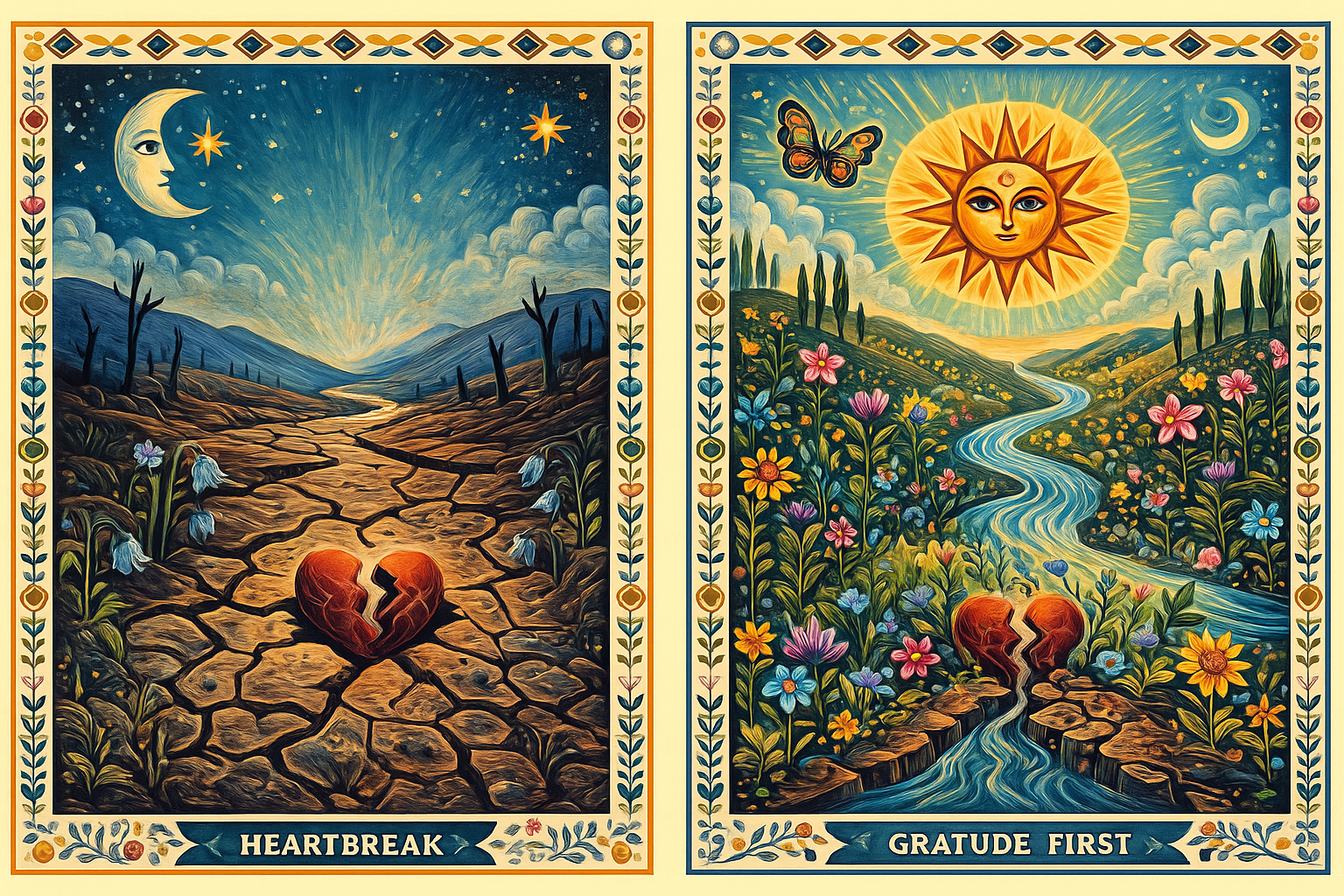
I’m taking a risk with this one. And my intention is not to be provocative. I am sincerely inquiring into the path of wisdom.
I want to fully honor the tragic connection between Thanksgiving and Indigenous genocide. Nothing I say here could possibly diminish the ongoing impact of the bestiality upon which our nation was founded. The tragic stain, the triad of genocide, chattel slavery and imperialism.
What I want to propose IS NOT that those of us who survived, that those of us who are still here, should forget our history when grappling with Thanksgiving.
What I am proposing is that we would not be here if our own ancestors did not know how to give thanks in the midst of devastation.
Why does gratitude become a survival technology?
Why is it not a betrayal of grief but an evolution through grief?
When you truly come to know the survivors of any trauma, whether individual or collective, you come to learn the ways of healing. When you come to know survivors who have found a way to heal you know they have earned the wisdom on the other side of grief. You come to know that eventually and inevitably, they got to a place of gratitude.
It is not that they spiritually bypassed or disassociated their way into functionality. But that they experienced the fullness of their heartbreak.
They somehow came to understand the distinction between a closed heart and a broken heart.
Yes. The heart will first tend to close and shut down. It has to. It is a way to get through the worst. But the heart that can heal is the heart that opens again, the heart that accepts that it has been broken open. And that still dares to stay open through the devasting grief.
This is the heart that comes to know that grief is the other side of love. The heart that has begged Spirit for pity. The heart that eventually gives thanks for life itself. The heart that comes to accept that to be fully alive, for as long as we are alive, includes accepting the tragedy of life and its terms.
There is a radical acceptance that brings radical freedom to the full reality of the human condition. This acceptance is not an acceptance that makes us defenseless, or denies us the courage to resist and to rebel and to take a fierce stance for the justice that is our birthright.
But it is an acceptance that turns toward life and its own terms. That understands that there has always been a horror to the human condition. It is easiest for us to feel the pain of the last 500 years. The still unfolding horrors of the Conquista. But it is essential to remember that people all over this sacred planet have been brutalizing each other for as long as our stories and archeologists can tell.
It is wise to let go of the story of an idealized past that was taken from us. It is an insult to the full and complex humanity of our ancestors.
This is not a way of saying “too bad, this is how it is, and how it has always been.” It is a way of saying that for as long as we have had evil, destruction, enslavement, and this endless fight for land and resources, we have also had the ways of wisdom. We have also had rituals and stories and paths aimed at easing the suffering of all beings.
We have had the teachers and the healers, the songs and the medicine.
And we have had the prayers — all of them:
The prayers of fear and protest:
“Let this not be so.” “Great Powers, protect us.” “Goddess, why?”
The prayers of surrender and seeking:
“We honor you.” “We seek you.” “We do not understand your ways.”
And the prayers of gratitude that arise almost impossibly:
“Thank you for life. Thank you for struggle. Thank you for the gift of Sacred Earth. Thank you for the opportunity to love you. Thank you for allowing us to get to love what we love.”
Our Ancestors Lived Full Rich & Complex Lives
The other day, it was the morning after ceremony and a most sincere young Black woman reflected on what she was learning: She said:
“My ancestors suffered so that I could have this. I get to have this.”
And Tuesday, my gorgeous, beloved, middle age Black woman said:
“Yes! Yes! Yes and…They also had full lives. They did not just suffer for you. They found ways to live and love through the tragedy of it all.”
You see, if we did not stay committed to our drums, and our songs, and our prayers, and our dance. If we did not have the wherewithal to hold on and to remember through the madness and the violence. Then we would not have the blessings of Indigenous culture. We would not have the world shaping power of Black American culture. We would not have the gifts of the still colonized people like those of my own island, Puerto Rico.
And at the heart of those prayers, and those stories and those songs is the seemingly irrational heart that says:
“Yes. Yes. And Thank You. Thank You for giving me life. Thank you for giving me a people. Thank you for letting us find subversive ways to keep our Ways. Because our Ways are our communion with you and with each other and with the teeming aliveness that permeates every mountain, desert, forest, jungle and water way.”
This is almost impossible to see while we are still in shock, trauma and grief. But we don’t have to wait for the horror to end before we start to find our way. Think about it. Generations were born and died through centuries of genocidal mania. There was no way they could wait.
They had to find their thank you in the middle of it all. And our people jumped brooms, danced and drummed, kept fires and told stories, remembered the ways of the elders and the warriors, of the lovers and the healers even when carrying grief that seemed too heavy to bear.
I will respect you if you refuse the Holiday of Thanksgiving.
I will honor you if your pain is still too big to find other ways and other days to say thank you.
We all do this at our own pace.
We are not even getting into the complexities of Thanksgiving Dinners within our families of origin alone! This stuff is as personal and intimate as it is generational and long.
And I want to honor that not everyone can access gratitude right now. Trauma has its own timeline, and each of us carries different inheritances, different wounds, different capacities. Refusing Thanksgiving may be the most honest and necessary choice for some. I respect that.
My invitation is not to override your truth, but to remember that our ancestors held many truths at once — rage and reverence, refusal and devotion, grief and gratitude — and that we, too, can walk with that multiplicity as we find our way.
Our anger can be righteous. Our fight for our birthright must go on.
But resentment will neither help you or serve you.
It will corrode your heart.
Why does resentment “corrode the heart”?
Well, because:
You will be giving up the one thing that our ancestors refused to give up.
You will surrender the liberating power of love.
You will miss out on the lessons of the narrow path of wisdom.
You will not get the radical freedom that comes from saying thank you.
Thank you. Thank you. Thank you.
That I get to live at all.