What About Christianity?: For those who feel a pull but don't fit the mold
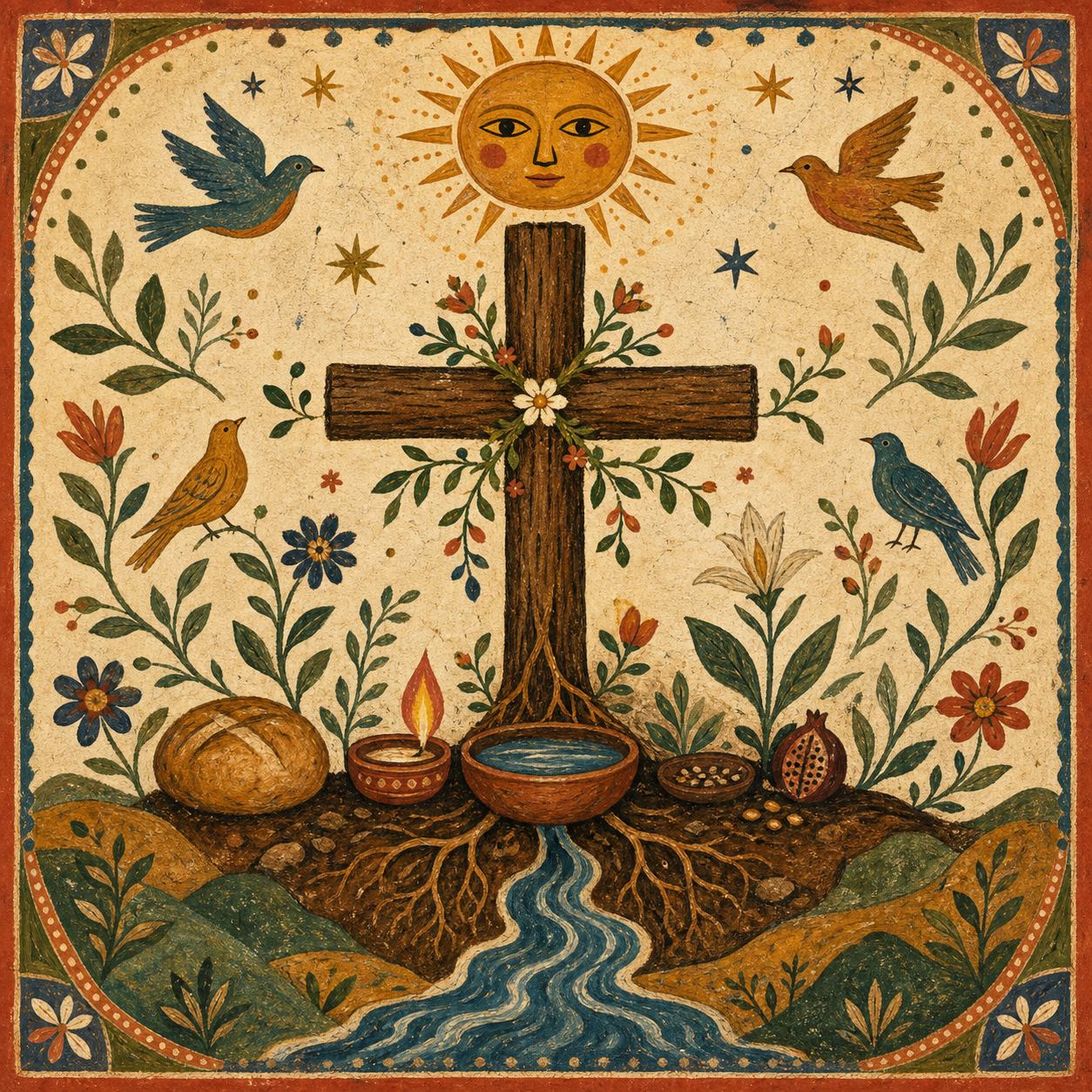
Last week, I invited you to join two public conversations on faith and religion. The talks are related but not the same. You might want to come to one but be less interested in the other.
The first conversation, Why are people returning to religion? is about the phenomenon of people going back to organized religion. And how it connects or not to the way you relate to spirituality.
REGISTER HERE and we’ll send you a calendar invite.
The second conversation is narrower. I want to highlight it here, for those of you who feel more called to this topic.
This note is for those of you who missed last week’s missive, and for those of you who were more likely to read a piece with “Christianity” in the title.
What you will find below is exactly what I wrote last week about the Christianity conversation, what it is and what it is not.
What about Christianity?
Wednesday, July 8, 2026
3PM to 4:30PM East
REGISTER HERE and we’ll send you a calendar invite.
What about Christianity?
There are many conversations to be had about Christianity.
This one is not a conversation for those who have animosity towards the Christian faith.
There are LOTS of reasons to have such animosity. There is plenty of church trauma to go around. The hurt of the colonized and the enslaved. The hurt done to those who are not Christian but live under its hegemony. The hurt of those who were forced into churches who did not welcome the fullness of themselves. The horrific patterns of sexual abuse systematically hidden by religious institutions. The contemporary political power and violence of Christian Nationalism and Christian Zionism.
This, however, is not that conversation.
This is a conversation for those who feel some curious or open hearted connection to Christianity, regardless of how unorthodox this connection is.
I myself am more of a neo-animist. This means that like all of our ancestors I know myself to live in relationship with a truly enchanted earth. A planet where everything is teeming with aliveness. (You can learn more about this from Josh Schrei: Animism is Normative Consciousness).
I am also someone who 22 years ago was miraculously and unexpectedly graced by a life changing initiation in the tantric tradition of Kashmir Shaivism.
One of my sisters best described it. She was joking about me at a family gathering, under the roof of my parent’s very religious household:
“Gibrán worships all the Gods!”
She said.
And in some ways it felt true.
I grew up in a rather unique corner of Christian fundamentalism. A Catholic “Covenant Community” within the “Charismatic Renewal.” (Justice Amy Coney Barrett belongs to something like this.)
What the heck does that mean?
The “covenant” part means that families who were members of our community went above and beyond what the church itself asked of them. They made a “next level” commitment to how they wanted to practice their faith. This commitment was sealed as a covenant that was renewed year after year. And some people could eventually take the leap and make a lifetime vow to live under this covenant.
The “charismatic” part means that we worshipped more like Pentecostals. Meaning, we prayed loudly, together, speaking different words, but all at the same time. We prayed in tongues, we placed our hands in prayer over each other and people fell down “slain in the spirit.” The best part was the vibrant singing with arms in the air and even dancing in ecstatic worship. Our was a Puerto Rican community, so you already know it had the fire and the flavor.
We were way more “biblical” than your average Catholic. On Sundays we gathered in an “asamblea” that felt more like an evangelical service. We did this for a couple of hours before heading to a more traditional Catholic Mass. We had men’s pastoral groups, and women’s pastoral groups, and youth groups, and prayer circles, and definitely a hierarchy!
There is no question that there was something beautiful about it.
But I’ve also had to do a whole lot of healing from the fundamentalism. Especially around the fear that they had of our adolescent sexuality. The homophobia. The focus on gender roles. And their fear of the broader culture, the culture of “the world” and “the flesh.”
The covenant was a call to keep us separate, a project to keep us apart from those who were not like us.
It is fair to say that I grew up in what is now understood as a “high control group.” Kind of cultish. But not really a cult.
In this long journey, with its many turns, and a lifetime of spiritual longing (Piscean ftw!) today I consider myself more of a Christian than I’ve ever been. But it is very clear to me that the vast majority of religious Christians would say that I’m definitely not a Christian. And it is true that I definitely don’t meet the qualifications outlined by their theologies and formal structures.
This is why I’m inviting you into the conversation.
Your story must be different from mine. But you might feel some connection to Christianity. Whether you grew up in church or not. And you might be curious about how others are making sense of this connection. Especially those of us who are not traditionalists. Those of us who do not meet “the qualifications.”
There is something missing in the ways most liberal reformers turn towards Christianity. You are often left with a blandness that lacks the faith in what is both unbelievable and miraculous about Christianity’s claims. Other theologies reduce the Christ to a Leftist radical, which is not untrue, but it does not invite the numinous either.
The numinous is that sense of encountering something that is both overwhelming and holy, something that exceeds all explanation.
I want to share how I turn towards the mystery of the incarnation, and to this archetypal story of redemption.
And I want us to have a conversation about where you find yourself in relationship with the creed that shapes Western Culture, whether we like it or not.
REGISTER HERE and we’ll send you a calendar invite.
I’m looking forward to being together.