A Culture Against the Descent
tl;dr: Our culture is organized against the descent, against our initiation into mature adulthood, and against the journey beneath the surface of our constructed lives. Our screens are designed to keep us from the journey. And yet this descent is the only path out of our cultural predicament.
Before we continue, I want to invite you into a live conversation hosted by John Wolfstone, a rites-of-passage guide, cultural regenerator and transmedia story-teller who also brought us the beautiful documentary “The Village of Lovers.”
We will be talking about moving From Fragility to Fortitude, some of the most important work that Tuesday and I have been developing since the racial uprising of 2020.
Register for this free event on Wednesday, April 15 at 2PM East
Now back to our regularly scheduled programming…
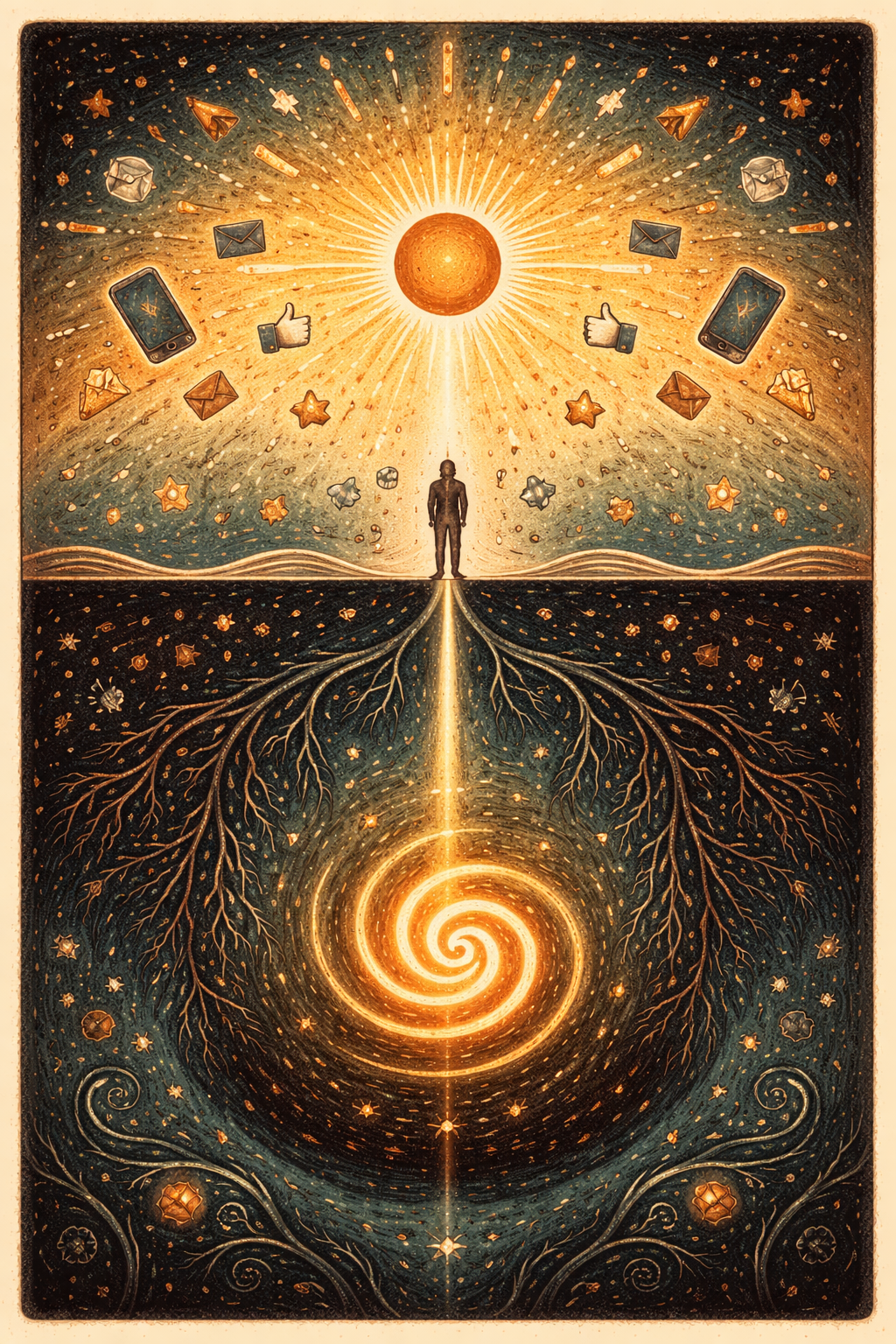
There is a journey that our culture does everything in its power to prevent you from taking.
I know there are cultures that have long standing structures to support, allow for, and facilitate what we might call the “the descent.”
There are yet other cultures that at least know how to make room for a person’s “descent,” even if it is a culture that lacks rites of initiation.
Dominant culture on the other hand, is organized against the descent.
What do I mean by “the descent?”
A descent is the process by which each one of us is drawn beneath the level of our constructed life. Beneath our persona and our competence, beneath the stories that organize our sense of self.
It is a movement from the surface of our lives to what is beneath the ground. It brings us into contact with what is more fundamental, more unformed, and more true.
You may have sensed the possibility of descent during one of those inevitable life moments when you realized that who you had been was no longer enough. We are not talking about a bad day or a setback. Not a challenge that you could recover from with rest or resolve.
We are talking about something more like the ground itself shifting. A sense that the self you had been relying on had run out of answers.
“Ordinary” difficulty or suffering can be endured at the level of the personality. You grit your teeth, adapt, recover.
That’s not what I mean by a descent.
A true descent takes you somewhere the personality cannot follow. It is not a problem to be solved from the surface. It demands that you go down. Not to collapse or disappear, but to move in a specific direction, downward and onward. Away from the light that has been organizing things, toward something older and less legible with the tools you are used to.
It can feel like death is coming. And of course we are organized to avoid death. Thank God for that instinct!
But what happens when what we call “staying alive” is just an anxious paddling? What if what we think of as “living” is just an exhausting effort to stay afloat while doing our best to look good when we are actually afraid of drowning? What happens when we know that we and those around us are caught in a consensus trance, a hamster wheel of busyness that only pauses for moments of vapid entertainment and way too much insomnia?
I’m not sure we should celebrate that way of life as our successful instinct to survive.
We are not just here to survive. We are here to flourish and to thrive. And for some hard to explain reason, these only become possible when we are willing to turn towards the dark.
This topic here demands much more than a newsletter. What brought me to write about it now is something hiding in plain sight.
Our screens are a great power that keeps us from the descent.
We have heard about shortened attention spans and the anxious depressions of doom scrolling. We know the way screens keep us from our families, friends and colleagues. It is hard to take a look at the way they impact our sex lives, and raise our children instead of us.
We know that the richest corporations on the planet wield the might of their resources to keep us algorithmically addicted to the lure of the black mirror.
It is a really tough moment. And it seems to be impacting anyone who can afford a phone and gets one. Everywhere across this sacred globe. Young and old. Rich and poor. Traditional and “modern” cultures.
We have heard about these impacts.
But I’m not sure we have paused to consider the way the screens keep us from the most difficult and most important journey. The journey of initiation. The journey towards adult maturation.
The screen in your hand is the most powerful obstacle (next to the culture of endless work) that keeps you from the descent.
Few are those who descend willingly into the dark. Now we have a technological daemon glued to the palm of our hand. It says to us all day long: not that, you don’t have to do that, you don’t have to feel that, stay here, and stay away from that.
And so here we are, caught in a predicament. The way out of the trap of a virtual world that hijacks our limbic system, extracts our attention and draws us into an abstract world without ground or real touch, is:
to become radically embodied
to turn more fully towards each other
to enter a reciprocal relationship with every aspect of this living planet
And none of these can be fully accomplished without the initiation of true descent.
But those parts of us that tremble before the very possibility of descent will gladly reach out and grab for the dopamine hit of the phone, the empty calorie that soothes us for a mere second before it starts extracting from us again.
There is no easy way out of this quandary. There are movements to get flip phones, or very expensive minimalist phones. I’ve been experimenting with a tool called “brick” that at least helps create a pause.
These structural interventions help.
Cal Newport recently wrote a good essay for the New York Times (sorry about the paywall) framing cognitive fitness the way we once came to understand cardiovascular fitness. It is something that requires deliberate practice and protection from harmful inputs. He recommends avoiding ultraprocessed content like TikTok and Instagram, reading books daily, keeping your phone out of reach at home, and pushing for phone-free meetings.
The throughline is that Newport frames cognitive fitness like physical fitness: avoid junk inputs, build in deliberate exercise (reading, writing, sustained focus), and reduce the environmental triggers that make distraction the path of least resistance. (See Newport’s recommendations below.)
All of this is good!
And it is important.
It creates the conditions that might help to unlock us from the pull of the screen in our hands.
But we are talking about the descent. And let’s remember that we did not want to go there anyway! That our breakthrough technology is borne out of a culture that is already paddling as fast as it can away from this journey to true adulthood. This journey of maturation.
So we begin by getting curious. By learning about the ways of wisdom. By knowing that there are beautiful and important paths that are ascendant, that bring us up towards the light. And that there are equally important paths, more ignored and less known paths, that are actually descendant, and help us to find the treasure that is hidden in the dark.
Bill Plotkin has spent decades mapping the terrain of the descent, what he calls the journey of soul initiation. And his work with the Animas Valley Institute is among the most serious and grounded efforts I know to actually facilitate this passage. Tuesday (my beloved!) and I have been partnering with them, and we have found their approach to be exactly what this moment calls for. They are not the only ones doing this work. But they are among the best.
The work we are developing around Crossing the Midlife Threshold is also a big part of this. You will find some quotes from different teachers that touch upon the descent.
Dr. Anna Lembke wrote Dopamine Nation, and broke down the science of a culture (a political economy) that is organized around addiction. It was overwhelming to read. As someone that is intimate with addiction, I had a moment of despair. I sat at the kitchen table and wondered how I could possibly protect my child from these ailments when I and the adults around me can barely keep from our screens ourselves.
I then paused, prayed, and remembered that we have always been concerned for the well-being of our children, whether we are afraid of famine, unjust Lords, enslavement, or invaders, there has never been a time when we have been truly “safe.” So now we fear the damage that screens and social media can wreak on the souls of our young. Just as we fear climate change and the failing of our democracies.
Ironically, it is the descent itself that provides an antidote to fear. It is what matures us into the courage to face life and its unyielding terms. We must somehow find a way to set the screen and the busyness aside. To allow ourselves to be taken into the journey of initiated adulthood.
There is a powerful 12-step tradition that has helped millions out of all kinds of addiction. (See Media Addicts Anonymous for your compulsive relationship with media and your phone.) It certainly is not the only path, but it is a well-trodden path, a path of:
Radical Surrender
Radical Honesty
Accountability
Fellowship
Prayer & Meditation
Service
Whatever your path may be, know that we recover our wholeness in relationship. In honesty. In the willingness to be seen by others who have agreed to walk the same narrow path. And it is from this ground that we can finally embark upon the descent. Not because we are no longer afraid. But because we are no longer alone.
In his New York Times Essay: There’s a Good Reason You Can’t Concentrate Cal Newport shares interventions that move us towards cognitive fitness.
His recommendations:
Avoid “ultraprocessed” content — Quit TikTok, Instagram, and X. He treats these like junk food: occasional exposure might be fine, but regular consumption isn’t worth the cognitive cost.
Read books daily — He proposes that a few dozen pages a day become the cognitive equivalent of 10,000 steps — a baseline maintenance habit for mental fitness.
Stop keeping your phone on you at home — His specific suggestion: charge it in the kitchen. If you need to check something, go to the kitchen. If you’re expecting a call, use the ringer. This removes the constant low-level pull on your attention without requiring you to fully disconnect.
Be deliberate about when you use AI — Use it for tasks that save significant time (sorting documents, fixing formatting). Avoid using it as a way to dodge mentally demanding work. His rule of thumb: your writing should be your own, because the effort of writing clearly is itself cognitive exercise.
Push for phone-free meetings — While this overlaps with institutional action, any individual can propose or enforce this norm in meetings they run.