A Little Of Everything This Week
This one is more of a digest, a handful of things worth your attention, along with a bunch of links:
“Follow Your Purpose” is Not as Romantic as it Sounds — Tuesday (my love, not the day of the week!) is walking away from the firm she built, and she wrote about it in a way that helps us learn about what it takes to separate.
Divine Intervention Gets the Peabody! — An update on the podcast about faith based resistance that I told about last year. It features my beloved elder, and it just won one of journalism’s highest honors.
From Fragility to Fortitude — An update on the body of work Tuesday and I are bringing into the world.
Liberalism and Virtue — What liberalism was supposed to be, and why it matters now.
Motherless — I’ve run out of words on patriarchy. Here’s what I have instead.
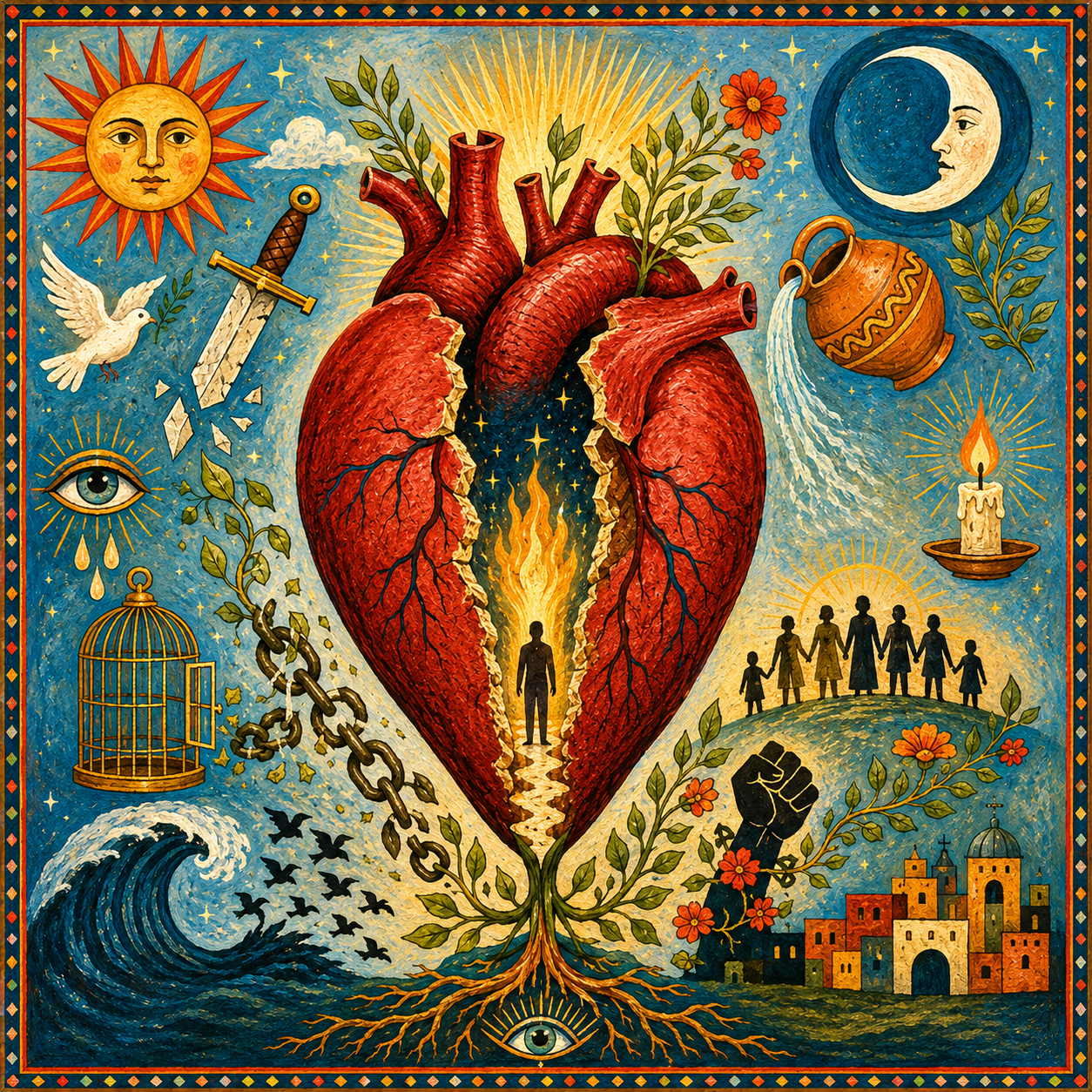
“Follow Your Purpose” is Not as Romantic as it Sounds
Most of the time, when you are truly called into the next stage of your life’s purpose, there is something to be let go of. It includes a “break up” with a shape of yourself that you are now called to alchemize or leave behind.
Tuesday, my wife, the wise and courageous woman that I live to adore, is now walking away from The Outside, the successful consulting firm that she devoted years to build and to serve. She just wrote a short and excellent reflection about it, and I strongly encourage you to read it:
Leaving the Outside: What This Is Not
“But the truth is deeper and more mysterious: hard decisions can be right decisions and still cost you something you love. They can break your heart on the way through. And a broken heart may be just what you need to do what’s next.”
Divine Intervention Gets the Peabody!
Last year I wrote a missive titled What Kind of Resistance? It included some reflections on Divine Intervention, the remarkable podcast about the Catholic Left and resistance to the Vietnam War. It features the life and one of my dearest elders, founder of the Interaction Institute for Social Change, my former boss: Marianne Hughes. It is produced by her son Brendan Hughes and it just got the prestigious Peabody Award! Check it out. You are going to love it.
If you are interested in participating in a live conversation with Marianne, register here and we’ll be sure to add you to the invite once we have a date and time.
From Fragility to Fortitude
Last week I asked you for feedback on the “soft launch” of a body of work that Tuesday and I have been building together and are thrilled to start to share. I am currently working on two follow up pieces:
Fragility and Therapy Culture
Fortitude, Strength and Heartbreak
Stay tuned for a series of podcast episodes Tuesday and I will be releasing before inviting you into an online course designed to help us move into this process of maturation.
You are not your wound.
You are what your people became in spite of it, and because of it.
The fear I hear most often when I raise this is:
If we give up the frame that centers the multigenerational and still unfolding devastation of our pain…
We let white people off the hook.
I understand this fear. But consider this: a hook that keeps us small is not a weapon. It is a cage.
Fortitude does not ask you to forgive what is unforgivable, or to minimize what is real, or to pretend that the structures of oppression are not what they are. It asks something far more demanding: that you refuse to let those structures determine the size of your soul.
That refusal, steady, clear-eyed, grounded in love rather than resentment, is more threatening to power than any amount of public grievance. Because it cannot be managed, triggered, or exhausted.
It is the gateway to a different kind of strength
Liberalism and Virtue
Ezra Klein is not what I would call a progressive. He is a committed liberal in that way that liberals can be both really smart and a bit annoying. But there is “liberal” as in “liberal vs. conservative,” and there is “Liberal” as in the very foundation of western democracy itself.
This episode of the Ezra Klein Show is an important conversation with Helena Rosenblatt, author of The Lost History of Liberalism, in an episode titled:
“The book that changed how I think about liberalism”
I bring this in because we find ourselves in a very real crisis of illiberalism, a global wave of authoritarian forces effectively seizing the reins of power.
Here I am highlighting the liberalism of Frederick Douglas and Martin Luther King, Jr. The liberalism that allows the oppressed to articulate a demand for freedom that demands we become people of virtue.
From Klein & Rosenblatt:
We live in this moment when illiberalism is winning, when illiberalism is in power. I don’t think anybody really argues against that. But what has surprised me is how weak liberalism has felt in response.
I’m a professional liberal — one involved in liberal politics — and even I don’t think I could tell you what liberalism’s vision is, or who its leaders are, at this moment.
… if illiberal political forces are going to turn back, I think you’re going to need a liberalism that is aspirational again. A liberalism that has moral imagination again. A liberalism that stands for more than “not this.”
… One thing that was interesting here was this idea that liberalism is built on a virtue, not a political philosophy… the old definitions of it… They have some kind of intersection between generosity and freedom… It’s really about having the freedom to voluntarily become the person that you should be.
Motherless
I’m stumped. I’m heartbroken. I’ve run out of words on patriarchy and its horrors. I’ve stayed quiet on this one for a couple of reasons. I’ve written a lot about men’s work and I’m praying for something new, something deeper to say. Some way to be and to transmit in a way that changes me and changes us.
What I know is this:
I am complicit.
There is no way to truly face the horrors of millenia of patriarchal violence until we see ourselves as fully embedded in it. I know I have caused harm, I have caused specific harm, not just generalized harm. And I live to atone for that harm.
It is a mistake for any man to be shocked by the travesty of a “rape school” and say: that is them. They are bad.
We are, each of us, responsible for this sickness.
I continue to gather men in ritual and ceremony space, to coach and to hold men. And to do my very best to support women who are healing and contending with this relentless onslaught of violence and pain.
I know I’m being ambiguous about this “motherless scandal.” And I make this choice because if you have not heard about it, there might be no reason to poke further at this ancient pain.
If you are indeed called to look closer, and I do think that male readers should, I close here with a few links for those who want to look further:
Sophie Strand screams her exhaustion and her pain in this intensely confronting piece:
Do you think I’m being overdramatic?
Elayne Kalila expands our understanding in:
What happens when the world is motherless?
Prentis Hemphill calls us to be:
Ian Mackenzie of The Mythic Masculine shares good wisdom on:
Alexander Beiner responds to Kalila’s piece with:
What happens when the world is fatherless
I am praying. I am praying for forgiveness, for integrity, for clarity, courage and the wisdom to do something that will help us all to change.
Thank you for reading. It is a blessing to be in community with you.