Fragility and Therapy Culture: Self-sovereignty and the path out of fragility
tl;dr: Therapy culture taught us to know ourselves. But knowing what's wrong is not the same as growing through it. When we stay identified with our wound, we stay fragile. It’s time to make a different move.
Before we begin, I’ve been meaning to acknowledge that the Supreme Court’s decision in Louisiana v. Callais is terrible news. It brings us closer to dismantling the very possibility of a multiracial democracy. I shared some thoughts prior to the decision in Let’s Not Surrender Our Democracy.
I also want to share this piece from Beyazmin Jimenez, a powerful woman I get to work with. I share it because I love Beya and I get to bear witness to the authenticity of her integration. I invite you to hear her voice: the gift of returning to my body
Now back to our regularly scheduled programming…
Last week I made the case that therapy culture has taught us to pathologize hardship. That piece was about belief, specifically about the belief that hardship itself is something that should not be.
This piece is about what that belief does to us.
It allows for modernity’s indictment of the human condition itself. It becomes fertile soil for resentment. And unchecked resentment is one of the primary ways we become fragile.
These pieces stand alone. But they are all part of a bigger argument, a body of work that Tuesday and I are calling From Fragility to Fortitude. Central to this body of work is the idea that we must mature our way through a cultural moment that made us fragile. It made us fragile under the very well-intended desire to provide healing and care and sensitivity. We’ve seen meaningful, life saving progress. But the discourse does not help us develop the fortitude that we need right now.
Tuesday and I often refer to ‘the discourse.’ It is our shorthand for a rigid, ideological dogma that took hold on our collective imagination. The frameworks of social and racial justice that, over the last generation, shaped how we talk about harm, healing, and power.
‘The discourse’ inadvertently becomes a vehicle that justifies resentment. It accurately analyses our shared condition. It is able to describe it and reveal it. But it is unable to nurture the necessary maturity to turn towards it without resentment.
Holding on to justifiable blame turns us into an eternal victim. And an eternal victim is endlessly fragile.
It is as simple as this: when hardship is no longer understood as part of life's terms, it is only understood as injustice. And since I stand against injustice, I get to enact my resentment. I get to indulge the fragility that comes with my woundedness, it becomes my currency.

I know many of you. We travel in similar circles. And in these circles there is an all too common experience that I know many of us share:
When someone’s “trigger” and sense of “harm” hijacks one of our convenings.
What is a better example of therapy culture and fragility than the mess that shows up every time the most hurt person in the room has a meltdown?
Most of the room freaks out. And the person goes on to demand that everyone else contort themselves to make them feel seen and safe.
It is an unreasonable demand.
But we mean well. So we try.
We want to undo centuries of harm. Harm that is unfolding. Harm that has not stopped.
But what we are inadvertently doing is allowing someone who is in a lot of pain to hijack the agenda and suck the power out of the room.
It is not that they don’t need compassion and care. And it is not that we don’t often find ourselves in rooms that are “triggering” and “problematic.” It’s just that we are not turning to it wisely.
We are instead acting and reenacting a pattern that keeps us stuck.
What we end up doing is incentivizing people to ‘rock their trauma,’ to leverage trauma in ways that grant power and attention.
Trauma is something we are here to work out and to heal from, it is not something that we are here to rock, to identify with and to leverage.
The kind of ‘topping from the bottom’ that is incentivized by this dynamic is not empowering to anyone involved.
‘The discourse,’ the influence of postmodern therapy culture on social justice work, keeps us stuck in the drama triangle. A bunch of people are doing their best to be ‘good,’ but no one is unhooked from the drama, no one is authentically empowered, and so we stay on the same loop.
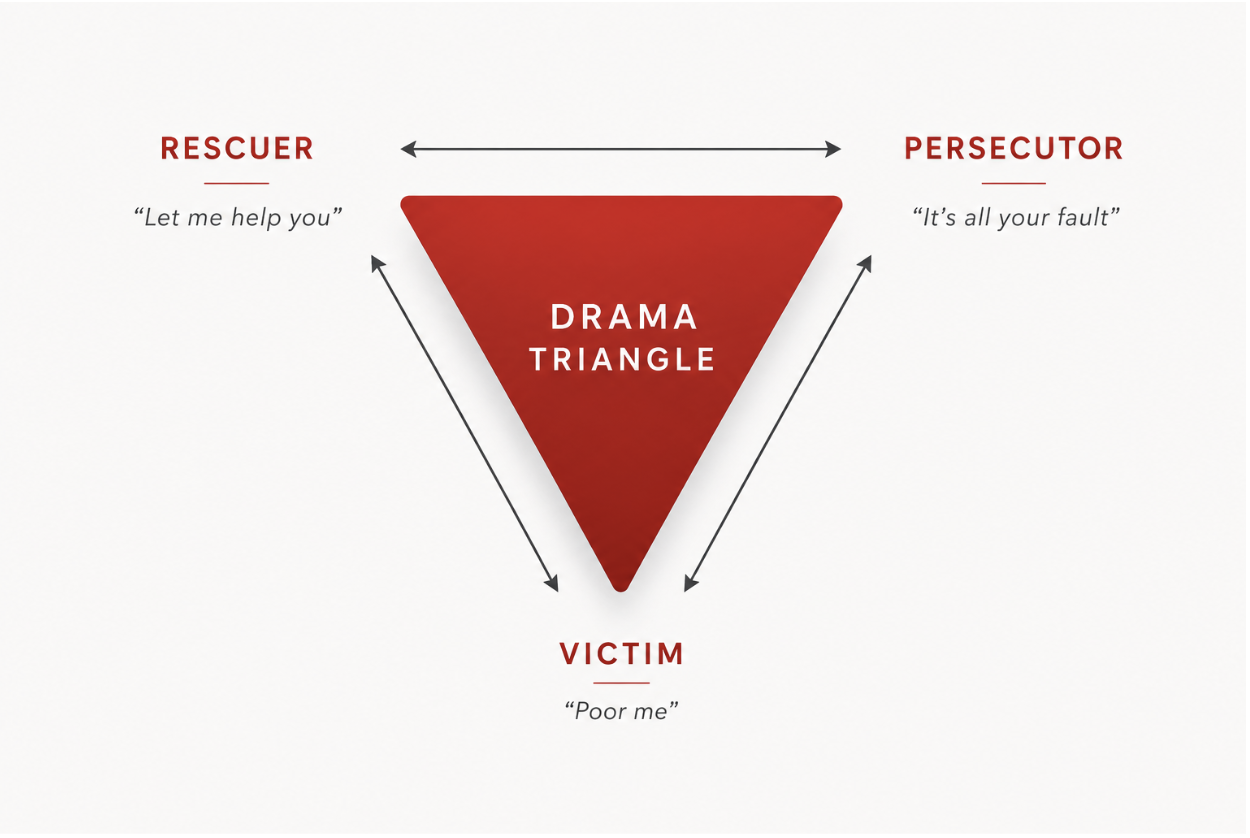
We experience this at every scale. In the room where the most hurt person hijacks the agenda. And in the “room” within ourselves. That vast interior room where all of our parts meet, and argue, and fight and hopefully learn to cohere.
How many of us are not already experts about our own psychological condition?
We can talk about our trauma, way too much about our parents, about our attachment style, what our nervous systems need… about how centuries of oppression continue to bind the fullness of our expression.
Our analysis is tight, but the drama keeps playing out. It plays out as the contempt between life partners. It plays out in those seemingly unbreakable patterns between parents and children and siblings. In the tussles with our colleagues and our bosses. In the bondage to that eternal frenemy that we can’t figure out how to let go of.
So many of us know what’s going on!
That’s the benefit of therapy culture.
We have the analysis. And the analysis is often right.
But we are not seeing enough progress, enough growth, enough healing, enough unlocking and maturation to have more of us stand strong and clear as attuned, sensitive and sovereign people.
We cannot find a foothold for freedom if our perspective is that we are the one that is always getting hurt.
Please don’t get it twisted! Do not confuse my words! I’m not asking anyone to be quiet and take it. I’m not asking anyone to keep their head down. What I’m saying is that as Tuesday put it the other day:
There is the “this is unfair” that comes from a child
And there is the “NO” that comes from within our sovereignty
If we remain in a stance of adolescent rebellion against what is, then we will never develop the agility and capacity to contend with the very real challenge of what is.
Self-sovereignty Instead of Fragility
Fortitude is a virtue of the self-sovereign individual.
The process of growing up, the process of developmental maturation, is a process of developing self-sovereignty.
I recently heard self-sovereignty defined as:
The capacity to remain in relationship with self, others, and reality without abandoning your awareness or agency. Not alone nor merged, but present and choosing.
From my perspective, one of the clearest indicators of self-sovereignty is your capacity to bring yourself to coherence when you are triggered or otherwise activated.
A self-sovereign individual is a person who stops asking the world (or family members!) to fix themselves around their wound.
Our hurt must be tended to. The process of healing is integral to our development. The move then is to shift our stance from a stance that tends to over-identify us with our wound, and indulges our resentment towards what is hard in our human condition. And to instead take on a posture that orients towards our maturation.
Towards our self-sovereignty.
And the fortitude that comes with it.
Next week we’ll continue our conversation with a piece on Fortitude, Hardship and Grief
PS: Maurice Mitchell of The Working Families Party effectively gets at part of this argument from a very different angle in: Building Resilient Organizations. I recommend it!