Fortitude, Hardship & Grief: Let’s find a stronger place to move from
tl;dr: Our time demands fortitude. Not toughness. Not stoicism. The time demands our capacity to bear difficulty without being undone by it. And the capacity to keep moving forward without being poisoned by resentment.
We are in the middle of the metacrisis.
The metacrisis is a crisis of crises. The crises of ecological collapse, technological disruption, economic fragility, mental health epidemics, political polarization, erosion of trust and spiritual disorientation.
It is a crisis unfolding at a civilizational scale.
And fragility is not going to cut it.
Our time demands fortitude.
Those of us who share an analysis of structural oppression have to face all of this with a heightened awareness. The awareness that we have already been living through a 500 year crisis! We have to contend with what our people have had to endure since at least the beginning of European settler colonialism AND we have to face the metacrisis.
These essays stand alone. But we have been making the argument that therapy culture taught us to pathologize hardship. That culturally, we see difficulty, loss, and suffering as things that should not be. In this way, we pathologize the human condition itself.
This set of beliefs breeds resentment. And resentment keeps us identified with our wounds. It keeps us looking for someone to blame. It makes it impossible to mature into the radical responsibility of a sovereign people.
It is resentment, more than the hardship itself, that makes us fragile.
The move from fragility to fortitude is the move from a stance of justified resentment toward a stance of self-sovereignty. Fortitude is a defining quality of self-sovereignty. Self-sovereignty develops as we become authentically mature adults.
Fortitude is the capacity to bear difficulty without being undone by it. Note that it is not the absence of fear or pain. It is the ability to remain functional, even purposeful, in the presence of fear and pain.
Fortitude is neither toughness or stoicism. Because fortitude doesn’t just endure. Fortitude endures toward something. It implies a relationship with suffering that is neither denial nor collapse, but a kind of steady reckoning.
It is essential to name that fortitude is our inheritance. It is our inheritance in the same way that generational trauma is our inheritance.
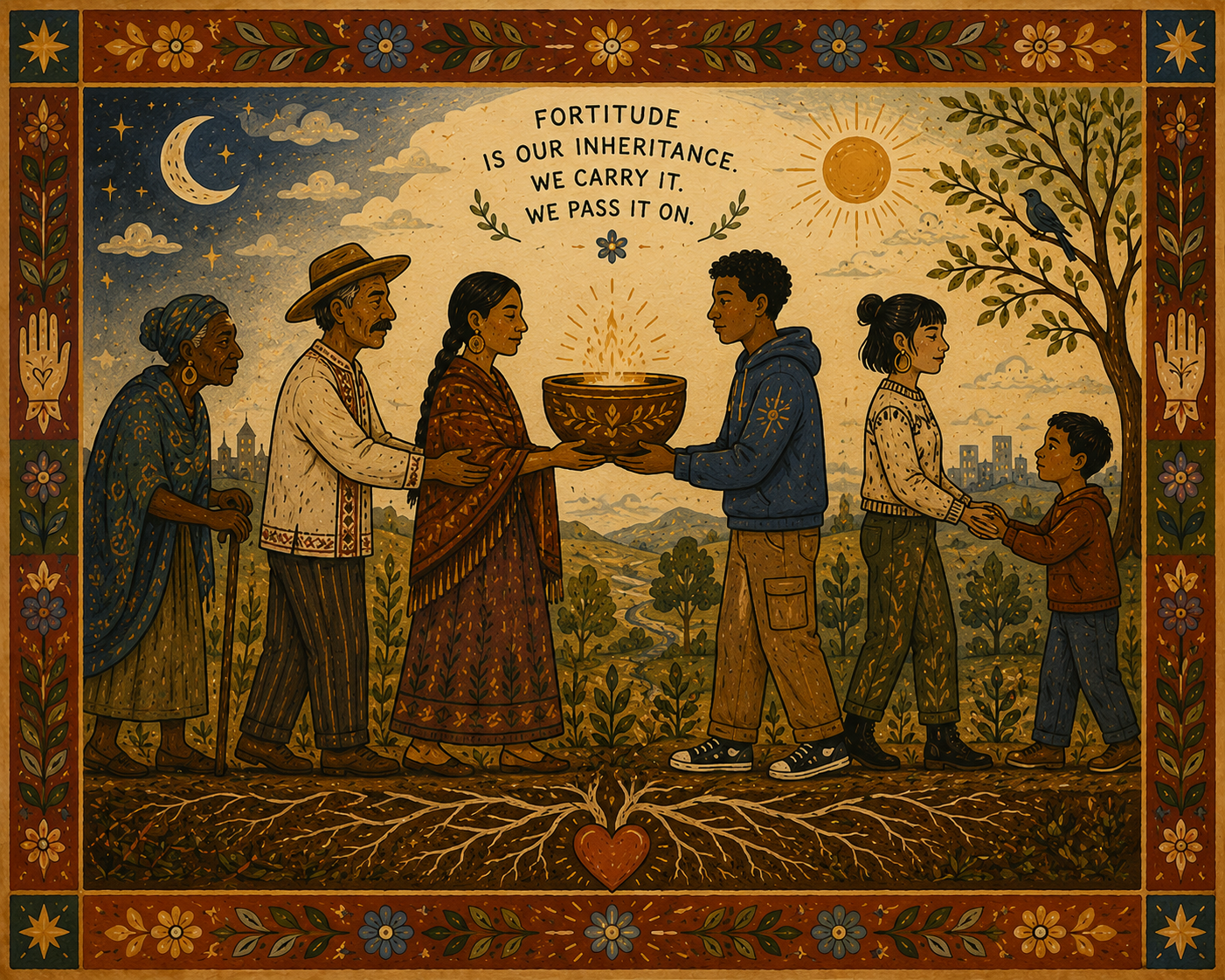
We come from people that have endured enslavement, genocide and imperialism. There is not one amongst us who would be here without at least some ancestors who embodied and transmitted fortitude from one generation to the next. Fortitude is how we made it this far.
But for some reason we keep getting stuck
We developed a sharp and accurate analysis of structural oppression. We understand the impact of multi-generational trauma, we get that there is collective trauma and family trauma, we certainly have personal trauma and we have a sense of the way these all intersect.
The whole situation makes for a profoundly unfair set of conditions.
And once you see it, it becomes impossible to unsee it.
My parents moved us from Puerto Rico (still a colony!) to Massachusetts when I was 12 years old. That’s when I became a minority. And I did not like it. I had no analysis. I had a direct experience. For the first time in my life, I was seen as less than. And I was seen as dangerous (even though I was just a boy!)
It wasn’t until I was 16 that I read The Autobiography of Malcolm X (shout out to my boy Juan, who told me I had to read it) and it was an awakening. There was, in fact, something terribly wrong, and it wasn’t us.
I latched on to Malcolm’s liberating analysis. The very clear black and white framework helped me make sense of the world for many years to come.
It seems like too much to let go of.
How dare anyone ask me to loosen the grip of an analysis, a way of looking at the world, that helps me make so much sense of this profoundly unfair set of conditions?
And yet! It is that tight grip that keeps us stuck. It keeps us coming back to the same dynamics, in the same rooms, with the same people. Especially with people we could be working with, or we are already working with.
We hold on tightly and defensively when we feel vulnerable. When we have been hurt. And when we feel like we might get hurt.
This is where you stop me and say:
“Gibrán! It’s not that we might get hurt, it’s that we are getting hurt right now!”
And I pause. And I take you seriously. And I consider my own experience. And I consider Tuesday’s experience. And I consider the experience of the remarkable people I get to work with.
And I have to say:
“Yes. We are getting hurt. Right now.”
And if it’s not us, not us immediately at this very moment, it is a whole lot of people that we care about.
How then do we turn towards the grief and hardship before us?
We don’t have to give up our analysis of how it works. Our understanding of how this mess came to be, and how it still comes to be.
Not all of it.
What we have to drop is any posture that locks us into the position of victim. For this is the posture that justifies resentment. It is the posture that makes us “good,” and the other “bad.” It is the immature posture of an adolescent.
The work here is to develop the mature sobriety to turn towards reality and say: this is how it is. We allow ourselves to feel the sense of injustice. To feel the hurt. And to truly feel the urge to do something about it.
But we find a wiser place to act from.
We find that place within that is not exactly toughness. It is not stoicism either. Because it’s neither about bearing it, nor about some sort of cool neutrality before our own existence. It is a coming into relationship with the ache in our heart, it is about coming to terms with hardship as something that “is so.”
And it is from that place that we endure, but we endure towards something. It is not that we become free of fear or pain. It is that we grow in trust, and in hope. We grow our own capacity for presence, our capacity to stay with what “is so.”
We are not only functional, we are purposeful. We are not in denial. But we refuse to collapse.* We reckon with the hardship and the pain. We feel it. We stay together. And we keep moving forward without being poisoned by resentment.
I like to encourage people to:
Become the kind of person others can turn to at a funeral.
That’s not the person that feels nothing. It’s not the person that tells you everything is going to be ok. It is the person who can be with their own pain as well as your own. It is the person who is more steadily coming to terms with the ways of hardship and grief.
To learn from a much better teacher, I recommend this recent interview of Pema Chödrön. This wise one reminds us that the only way out is through. She reminds us that we are not trying to get rid of what we are feeling. The work is to become intimate with it. She is not exactly talking about acceptance. She is inviting us to develop the willingness to be here, fully, with an unconditional warmth toward your own experience. Until it becomes workable.
She doesn’t use the word fortitude. But this is what I mean by it.
We become fragile when we just don’t want to have the feeling. And we just don’t want things to be as they are. And we wield our analysis to blame and resent and justify our feelings of interior collapse.
Life can be hard. It is definitely going to hurt. And that hurt is not evenly spread. There is something terribly unjust about the way certain groups of people bear the burden of this pain.
The invitation to fortitude is not an invitation to just let things be as they are. It is an invitation to find a stronger, cleaner, freer place within you, and to learn to move from this place.
The process of maturation that we are talking about here is one that simply cannot unfold within the grip of identitarianism.
But it is also a process that cannot happen without a sense of belonging to a people.
Fortitude is not something we cultivate alone. It is what grows between us when we grow into integrity, into radical responsibility and into an ever expanding web of mutual care.
This work is not for everybody.
It is up to you and up to me to become the kind of people others can turn to at a funeral.
*To be clear here, grief will take each one of us to a place of collapse. That “bow down” grief that can re-make us into wise humans we never thought we could become. That is not the type of collapse I’m talking about here. That collapse is good and inevitable. I’m talking about refusing the collapse that comes from victimized fragility.
Read the series from the beginning: